Monday, June 21, 2010

The Incredible 1980s Power Looks of Prom Night II: Hello Mary Lou

Prom Night II: Hello Mary Lou (or Hello Mary Lou: Prom Night II depending on what country you're from) is a horror film from 1987. It shares literally nothing whatsoever in common with it's predecessor, Prom Night, other than, yes, a prom is involved in each. This sequel revolves around the ghost of "Mary Lou" (Lisa Schrage), a high school slut who died at the prom in 1957 and has now taken over the body of "Vicki" (Wendy Lyon), a plain - some may some homely - schoolgirl who was recently nominated for Mary Lou's coveted Prom Queen title.

The movie is generally uninteresting and, much like Prom Night, is kinda boring and has that washed out look that a lot of 1980s horror flicks have. What is incredible about this movie is how completely and utterly 1980s it is. The fashion! The hair! The new wave music ripoffs! As I watched this movie I got the unsinkable sense that Flock of Seagulls had been really popular in Canada at the time. Oh yeah, this is a Canadian movie! It's basically what would happen if the cast of Degrassi performed an amateur production of Carrie!


Sunglasses... on a chain (but not at night)! Oh lordy.


A pearl necklace, floral knit tops, big pop star hair and chunky earrings. Oh yes.


I had a "boombox" just like that when I was a young'n.


You cannot deny that this is incredible.


This is Beth Gondek playing "Jess" who looks like Joan Cusack in Working Girl, but even funnier because, umm, this is set in a Canadian high school, not New York City. Jess has a secret - at first I thought she was a lesbian who was in love with Vicki, but it turns out she's just preggers to a creep who won't call her back! Mary Sue's demonic spirit throws her out a window. Poor Jess. POOR JESS' CAPE!


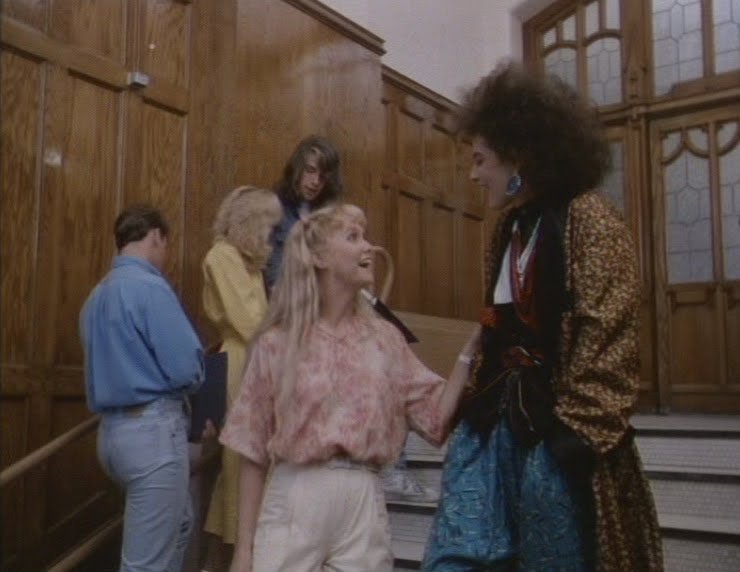
I see so many different hair styles in just these two images. And that's a big "Hello!" to the shirt that guy is wearing in the first picture (I never caught that character's name.)


Is that scene set in a gymnasium or a fashion mall? I never can tell with the 1980s.


I just find this picture amusing, don't you?


I love that people wore this shit TO SCHOOL!


I'd like to point out that that first image is a school teacher caressing the buttocks of Vicki. Yes, a teacher. Amazing. That second picture? Okay, there's an entire scene in Prom Night II: Hello Mary Lou in which Vicki chases her next victim completely starkers. And I don't mean in any Austin Powers sorta way, I mean complete head to toe nudity. Way too much vagina in this scene, thank you very much. It's the most ridiculous thing in the entire movie and that's saying something!


I love that this Prom looks like nothing more than an Oingo Boingo videoclip with some fluorescent stripping.


Look at that computer! It makes The Net look positively modern!


What losers.

This next shot, the final one thankfully, isn't particularly "omg how funny were the '80s?" but I found it equally as hilarious. It's right after Vicki has won the title of Prom Queen and she stands on stage accepting her crown, but she's not elegant at all. She stands up on the stage in the high school auditorium like she's Ethel Merman on a cruise ship.


And that's basically all I have to say about Prom Night II: Hello Mary Lou other than to share with you my favourite moment from the movie. Favourite because it was so unexpected. Don't have the volume on at work though, kids!

Thursday, June 10, 2010

Black & White Friday: GrindHouse


The Robert Rodriguez/Quentin Tarantino double bill that made up Grindhouse seems like a natural fit for "Black & White Friday", in which we look at what films may have turned out like - for better or worse - if they'd been made in another era. Since Grindhouse took its inspiration from b-movies (specifically Rodriguez's Planet Terror) and exploitation (Tarantino's Death Proof) that were routinely filmed on cheap black and white film stock I thought it made a great subject matter.


Back when I took a look at Gregg Araki's The Doom Generation in black and white I wrote "Oh the things Russ Meyer could have done with Rose McGowen!" and nowhere is that more apt than here. I like the idea of a movie in which Rose McGowen leads a group of maniacal, big-breasted women who have just escaped from Prison who go on the run fucking and killing any man that dares get in their way. It would be incredible, yes?


Apologies if this entry just descends into me saying things like "OMG LOOK AT THAT!!!" and "AMAZING!!!!!!" but these two movies are incredible and that's basically the reaction I have each and every time I watch them. Doesn't this just looks awesome? The added grain, scratches and all 'round retro feel certainly helps in this feature, doesn't it?


I find it funny that Fergie has appeared in three movies that were throwbacks to classic cinema. She has had cameos in Grindhouse, Poseidon and Nine. Maybe there's more to Stacy Fergie Ferg Ferguson than meets the eye? Or perhaps there's less (she does voice a character in Marmaduke after all!)


I have nothing to say, I just like the shot.


This most definitely looks like something out of Them! or from something of that ilk. All we need is a big "NOOOOO!" and the scene would be complete.


There is nothing about Rose McGowen having a MACHINE GUN FOR A LEG!!!! that is not incredible and not even black and white can destroy that beautiful image. And while the idea of a character having a MACHINE GUN FOR A LEG!!!! sorta negates the retro vibe since it so clearly wouldn't have been doable "back in the day", Rodriguez does a far better job at keeping up the grindhouse feel for the longest. Quentin Tarantino all but forgets about it from an aesthetics point of view during the second half of Death Proof. And so while I think Planet Terror is the lesser of the two films, its dedication to its idea is so wonderful that I love it all the same.


Oh Death Proof. How I love thee.


Although, to be perfectly honest, I prefer the title "Thunder Bolt".


I know this scene cops a lot of flak from people, but I love every single second of it. Every word, every camera angle, every blemish on the reel. I haven't seen all that many of the kind of movies that Quentin Tarantino was riffing off of, but their whole talking-shit-and-not-much-else vibe comes through loud and clear. I could listen to these characters talk about shit for even longer!


Curiously - and I'm sure the farthest thing from Tarantino's mind - the movie that this shot reminds me of is Orson Welles' Touch of Evil with its US/Mexico bordertown and bubbling violence. All the other shots still feel like they're out of an exploitation movie, but this one is completely different. In colour it fits, but in black and white it has that film noir aesthetic with all those shadows.


I love how cheap and nasty this sequence looks, which is why it fits into the grand scheme of all things Grindhouse very nicely. Rose McGowen doesn't have a MACHINE GUN FOR A LEG!!!! in Death Proof, but despite the bat wig she slots in perfectly. She just has that look of an actress that wouldn't have been able to make it in the big leagues due to her BIG looks and overt sexuality and would've had to appear in these genre grindhouse titles that flaunted her sexuality. Come to think of it that is exactly what happened to Rose McGowen. She's not much of an actress when working outside of her indie/genre/indie genre comfort zone, but just try and remember how beguiling she was in her Black Dahlia cameo, or how much edge she had earlier in her career in movies such as The Doom Generation, Scream and Lewis & Clark & George and then think of projects like Jawbreaker, Phantoms and Charmed.


This is gorgeous.


Not much of Death Proof's second half suits itself to black and white since Tarantino all but ditched the visual component of it, but this shot is made for it. Basically because movies don't say "THE END" anymore, but it still looks great nonetheless.

Friday, June 4, 2010

Black & White Friday: The Crucible

Welcome back to another series of "Black & White Friday" where, if you're relatively new to the blog, we try to reimagine movies as if they had been made in black and white. it's quite simple, really. Sometimes films lend themselves to it - which really just exemplifies how much we're still indebted to the crafts and skills learnt during the black and white era - while sometimes the film's don't at all, which can show how far we've come. It's a neat little experiment that I tried once and that I enjoyed so much I kept on doing. I can't promise one of these every Friday, but season three is here so please enjoy!


I was inspired to watch Michael Hytner's The Crucible after an episode of Who Do You Think You Are in which Sarah Jessica Parker discovered she was descended from somebody who was persecuted for being a witch. This being a very American story my knowledge of the history was vague and while I am perfectly aware that The Crucible is not historically accurate in many things, I found it quite fascinating nonetheless.


The first thing that flashed into my mind at this moment was Michael Haneke's The White Ribbon, obviously, which has a near identical town "who did it" meeting (if I am remembering correctly). It reminds me, too, of what Haneke said about making that film in black and white. He did so because our brains have always associated that time period (pre-WWI) with black and white images and photography so, to him, it made sense to make the film in black and white. That way it's as if we're seeing it as a part of a historical context that wouldn't be there if the film was to be made in colour. I am paraphrasing, obviously, but that's the general gist of what he said.


This image, specifically in black and white, makes it appear to be much more of a gothic horror tale than it really is. The Crucible is about witches, but it isn't about witches. So, it's not The Craft.


Back to black-and-white-recreating-olden-times from the first shot, perhaps The Crucible would have truly benefited from it. There's a coldness and a purely white vs black/good vs evil that would have been at play if it had have been. Of course, the character played by Daniel Day-Lewis is far too modern to fit into any movie of this time period so it might all be moot.


This kinda reminds me of the works of Ingmar Bergman in a way, the ones like Sawdust & Tinsel that were set in wind-blown Scandinavian town of small populations.


This shot intrigued me because it was so thick with fog, blue fog and in black and white it reminds me an old movie with a bad DVD transfer where everything is a little fuzzy and soft and barely visible.


I really liked this shot in colour with the deep blue and black night sky and this small sliver of fireplace emanating out of the doorway. In black and white it doesn't look anywhere near as good.


I chose this shot because Mary Pat Gleason does not get enough love from anywhere.


I wish director Nicholas Hytner (he of Centre Stage, thank you very much) had made a hard and fast decision about the depiction of the girls. Either he should have gone for broke and just made them a Village of the Damned-esque troupe or not at all. It kinda felt half-arsed the way he did it. Like he wanted his Gothic cake, but wanted to eat the serious drama, too (wait, that doesn't sound right). It makes for an odd imbalance.


The one scene that I thought Winona Ryder really clicked as Abigail was in this scene. It shows her abilities of manipulation perfectly without even the slightest hint of alpha-ism and self-consciousness. It was like during this scene that her character really did truly start to believe everything she was saying. Giving the performance of her life. Unfortunately for Winona I think she was miscast here. I think she was too old for the part, especially when so much of the character comes from her youth. I read that they changed the character from 12 years old to 17 due to the new romance subplot, but even those moments between Daniel Day-Lewis' Proctor and the character of Abigail would have been far more effective if played by someone younger. Abigail being so young and yet so able to convince everyone of her "truth" adds a whole other dimension that the film lacks. I also think, much like Day-Lewis, she acts the role as too modern. This scene she got it right though.


What a moody and dark shot to end on, but the last 20 minutes or so of The Crucible is all moody and dark and depressing and not too much fun (especially since Daniel Day-Lewis' teeth somehow go from sparkly to rotten in but a few days). It's clearly the weakest part of the movie and doesn't even look particularly interesting in black and white, either. I haven't mentioned how good I thought Joan Allen was (she is in this shot), or how fantastic Paul Scofield was. It's a shame he wasn't nominated for an Oscar.

And so we're done. I hope you enjoyed it and I hope I get some a few more of these out before I tire of it yet again (...). If you weren't around these parts the last time I did this series then do check them out. Some of my personal favourites include Showgirls ("Nope, not even black and white can make this bit classy"), The Others ("there are moments in The Others - like this scene, which feels like a lost outtake from Jacques Tourneur's Cat People"), Chicago ("it looks like some sort of surreal Lynchian experience."), Femme Fatale ("is there anything quite as beautiful as Paris in black and white?"), The Net ("Sandy's hair is too messy."), Birth ("I think it's quite obvious to everyone and sundry that Jonathan Glazer was fixated by Nicole Kidman"), Open Range ("You could be forgiven for thinking this was A Boy and His Best Friend"), Moulin Rouge! ("Proof positive that Nicole Kidman would've been a star in any generation"), Reds ("It really is somethin' else, isn't it?"), The Doom Generation ("Oh the things Russ Meyer could have done with Rose McGowen!") and The Exorcist ("This moment is scary no matter what the colour scheme.")